




There is a particular kind of exhaustion that sets in when the pace of change becomes structural rather than cyclical. Leaders across Australian businesses know it well. It is not the fatigue of a single disruption but the cumulative weight of operating without a stable baseline: economic volatility, talent constraints, cybersecurity pressure, and now a technology landscape reordering itself faster than most organisations can respond.
In that context, the question most leaders are quietly asking is not “how do we adopt more AI?” It is: “How do we hold things together well enough to move forward?” That is the right question. And it is worth sitting with before adding anything else to the mix.
Is your IT foundation built to carry what comes next?
AI is already reshaping the economics of IT – not incrementally, but structurally. Agentic AI represents the next stage of that shift: systems that don’t just assist but act. Agentic AI makes decisions and executes tasks across environments without waiting for instructions.
The cost model of delivering technology services is shifting as automation absorbs work that once required full-time headcount, and as infrastructure increasingly runs itself. But not all AI adoption delivers the same return and the gap between organisations that benefit and those that merely spend widens at each stage of maturity.
Recent global research describes what is in motion as the largest organisational paradigm shift since the industrial and digital revolutions: one that unites humans and AI agents to work side by side at scale, at near-zero marginal cost.
For IT leaders, the question is not whether to move; it is understanding where they are starting from:
| Manual effort | AI-assisted | Agentic AI | |
|---|---|---|---|
| What it does | People run IT operations such as monitoring, responding, and resolving issues as they arise | AI surfaces insights and recommendations; people review and act | AI acts independently - monitoring, deciding, and resolving across the environment without waiting to be prompted |
| What it delivers | Familiar and controllable, but slow, inconsistent, and expensive to scale | Faster decisions, fewer blind spots, reduced burden on operational staff | Continuous, proactive IT operations at a fraction of the cost with fewer outages and greater resilience |
| What it requires | Skilled people and clear processes: the baseline every organisation needs | Defined workflows, good data, and human oversight of what AI is recommending | Clear accountability structures, governance frameworks, and leadership that knows where humans must stay in the loop |
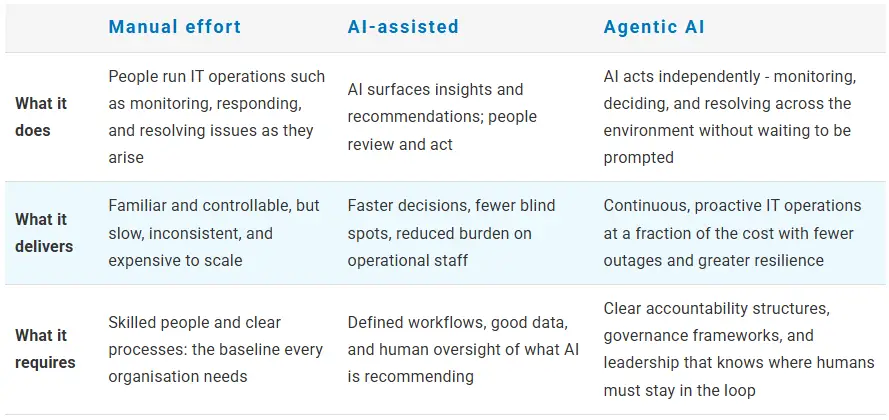
The AI-enabled organisation is not simply one that runs on AI. It is one that understands where it sits in this progression, governs the transition deliberately, and does not mistake activity for maturity. That is a harder, slower, more human piece of work than the technology itself. It is also the piece that determines whether the investment pays off.
Humans and AI agents: Designing the new collaboration

Agentic AI marks a meaningful escalation. Where earlier generations of automation executed defined tasks, agentic systems plan, act, and orchestrate across workflows with far greater autonomy than most organisations have yet designed for. The productivity case is compelling, but so are the governance questions. The evidence is clear: the true limiting factor will no longer be technology’s capabilities but humans’ ability to oversee and manage agents. The organisations that extract durable value from agentic AI will be the ones that built clear accountability structures before they needed them, not the ones scrambling to retrofit governance after something goes wrong.
The leaders who will thrive in this environment are those who blend human depth with digital fluency. They will use AI to think with them, not for them. That distinction plays out differently across industries, but the principle is consistent: AI accelerates execution, while humans hold judgment and accountability:
- Banking and fintech - AI agents handle fraud detection, compliance checks, and loan processing workflows at speed; relationship managers and credit officers retain the decision and the client relationship.
- Accounting and professional services - AI agents manage document review, reconciliations, and preliminary reporting; senior practitioners focus on interpretation, advisory, and client trust.
- Non-profits - AI agents streamline grant applications, donor communications, and volunteer coordination; mission-driven leadership remains the domain of people who understand the cause.
- Healthcare - AI agents triage patient intake, manage referrals, and process insurance claims; clinical judgment, informed consent, and care conversations stay firmly with practitioners.
- Law firms - AI agents conduct contract review, legal research, and discovery processing; matters requiring counsel, strategy, and ethical accountability remain human responsibilities.
Human-AI collaboration, done well, is not about dividing tasks down a list. It is about designing the interaction between human judgment and machine capability so that each amplifies the other without either substituting for the other’s essential role. That design work requires leaders who have done the thinking about where the boundary sits, and who are prepared to hold that line under pressure.
Leveraging AI to strengthen the operating foundation
Managed service providers occupy a particular position in this landscape. They are, in effect, the shared services layer for IT absorbing operational complexity on behalf of the organisations they support, so those organisations can focus on what they do best. That role is not diminishing in the AI era. It is becoming more consequential.
AI agents are transforming how corporate services and workflows are run: automating tasks that previously consumed time without generating value, and creating better outcomes for employees and customers alike. For MSPs, this creates a real capability step-change: the ability to monitor, triage, respond, and remediate at a scale and speed that was not achievable with human effort alone. What used to require a team working reactively can increasingly be handled by systems working continuously.
But the value proposition of a managed service was never simply speed of response. It was reliability. The confidence that your IT environment would work when you needed it: that issues would be caught before they became outages, that someone was accountable when they were not. AI changes how that reliability is delivered. It does not change what reliability means.
That distinction is worth holding onto. In an environment where technology is evolving rapidly, the leaders and organisations that rely on IT partnerships are not primarily asking for innovation. They are asking for certainty day in and day out. They want to know that the systems underpinning their business are governed, protected, and maintained with the same rigour today as they were last quarter, and that the humans responsible for that governance have not been replaced by systems that have no one to answer to.
The MSPs that position AI as an amplifier of accountability, rather than a replacement for it, will be the ones that continue to earn that trust. And the distinction will show up not in product roadmaps or AI feature lists, but in how consistently the lights stay on and how clearly someone can explain why.
Leading from the inside out

There is a temptation, in this environment, to treat AI adoption as primarily a technology decision. It is not. It is a leadership decision.
The research is unambiguous: AI is not a tech challenge that can be delegated. The leaders who will thrive in the AI era are those who engage directly – who develop their own fluency, experiment personally, and make deliberate choices about what to automate, what to govern, and what must remain human. That is not a call for every executive to become a technologist. It is a call for every executive to lead with the same clarity in technology decisions that they bring to any other domain of the business.
The core insight that thriving leaders blend human depth with digital fluency is not primarily about skill acquisition. It is about posture. The leader who approaches AI as a domain to be curious about, rather than one to be managed from a distance, will make better decisions about it. They will ask better questions of their providers, set clearer expectations for their teams, and be better positioned to course-correct when the technology underperforms.
What digital fluency looks like in practice
Not every leader needs to build AI systems. But every leader navigating this environment benefits from internalising a handful of defining practices:
- They ask what not to automate, as deliberately as they ask what can be. Restraint is as valuable as capability.
- They experiment firsthand, not from a distance. Practical experience shapes better judgment than delegated insight.
- They define risk appetite before deployment, not after failure. They are clear on what acceptable risk looks like in their environment.
- They set accountability before going live. Ownership is defined upfront, not discovered when something goes wrong.
- They evaluate IT partnerships on governance as much as capability. They ask not just what technology can do but how reliably it is controlled.
In the context of managed IT, this translates directly. The most effective MSP relationships are not transactional; they are partnerships in which both parties bring clarity about what they are trying to achieve and honest conversation about where the gaps are. Leaders who have done the internal work of understanding their own risk appetite, their tolerance for automation, and the non-negotiables in their operating environment will get far more from those partnerships than leaders who outsource that thinking along with the infrastructure.
Leading from the inside out means knowing what you stand for operationally before you decide what technology to stand behind. It means having the conviction to say: these are the systems we rely on; these are the standards we hold; and, this is the accountability structure we will not compromise regardless of what the technology makes possible.
The certainty standard
Most Australian businesses do not have the luxury of large internal technology teams, multi-year transformation programs, or rooms for missteps. The margin is thin, and the cost of unreliable IT shows up quickly in operations, client relationships, and the ability to move forward with confidence.
The question, then, is not whether AI will reshape how IT is run. It already is. The question is whether leaders are ahead of that shift or reacting to it.
The organisations that come out well won’t be defined by the sophistication of their deployments but by the clarity of their decisions: what they need to rely on, who is accountable when it fails, and how they ensure technology continues to serve the business rather than drift from it.
Those are leadership questions before they are technology questions. They require clarity about what to automate, what to govern, and where human accountability must remain.
In an agentic age, certainty is not a by-product of technology. It is a leadership decision.