




The pilot era is over. What comes next is harder.
The pilot era of AI is ending. What began as experiments in productivity, e.g., generating system documentation, synthesising logs, producing initial assessments, is now becoming operational infrastructure. AI is moving from something teams try to something teams depend on. The question has shifted from “should we adopt AI?” to something more uncomfortable: “are our people ready for what we’ve already adopted?”
This is where most organisations stall. The technology is deployed; the capability around it hasn’t been built. Research on the shift from experimentation to embedded adoption shows that the move from pilot to production is real and accelerating, but it’s not primarily a technology story. It’s about organisational redesign, cultural trust, and the capability of the people expected to work alongside AI every day.
The gap between what AI can do and what organisations can absorb is widening. That gap is where value stalls.
The intensification paradox
The promise was straightforward: AI would reduce work. Automate the routine, free up time, let people focus on higher-value tasks. It’s a compelling pitch, and in pockets, it’s true.
But the reality is more complex. Findings that AI intensifies rather than reduces work point to a pattern that many teams are experiencing but few have named. AI doesn’t reduce work – it reshapes it. When AI takes over routine tasks, new demands appear in their place: governing outputs, integrating systems, validating quality, coordinating across teams, making judgement calls that didn’t exist before. The work doesn’t disappear. It changes shape, and it changes shape faster than most teams are prepared for.
This is the intensification paradox. The tools that were supposed to lighten the load have introduced an entirely new layer of work, and nobody budgeted for it.
Consider what actually happens when a team adopts an AI assistant. Someone has to evaluate whether the outputs are accurate. Someone has to decide which tasks are appropriate to delegate and which aren’t. Someone has to monitor for drift, bias, or errors that compound over time. Someone has to integrate the AI’s work into existing workflows without creating duplication. These aren’t edge cases: they’re the daily reality of working with AI, and they require judgement, not just technical fluency.
The freed-up time only becomes higher-value work if someone deliberately decides it should. Otherwise, it becomes headcount pressure with better tools. The technology isn’t the problem. The missing decision is.
The human premium

So what does AI actually free people to do?
The work that remains (and the work that grows in value) is the work AI can’t do. Judgement. Contextual reasoning. Relationship-building. Ethical discernment. The ability to hold ambiguity and still make a call.
The economic case. Premium proficiencies tell the story: as AI absorbs the routine, the premium shifts to human-centric capabilities – critical thinking, emotional intelligence, complex problem-solving. This isn’t a sentimental argument about human worth. It’s an economic one. The tasks AI can’t do are now the most valuable tasks in the organisation, and they’re the hardest to hire for, train for, and scale.
The elevation argument. Corroborating evidence arrives from a different angle. AI works best when it handles the searching, synthesising, and drafting, while people move toward relationship-building, problem-solving, and judgement-rich decisions. The point isn’t that AI is weak; it’s just about freeing people to spend more time on the work that actually requires a human, and less on the work that doesn’t.
But here’s the tension.
The very work that builds human expertise, i.e., the routine, repetitive tasks that juniors cut their teeth on, is the work AI is taking first.
Who trains the next generation?
Expertise has always been built through apprenticeship. Juniors do the routine work, make the small mistakes, build pattern recognition, and gradually develop into senior practitioners. It’s how every profession works, from medicine to engineering to sales. You learn by doing the foundational work, and you build judgement by seeing a thousand variations of the same problem.
When AI absorbs that foundational work, the apprenticeship pipeline changes.
If juniors don’t do the routine work, how do they develop the pattern recognition that makes them valuable seniors? If the first draft is always AI-generated, where does the junior learn to write? If the analysis is always AI-synthesised, where does the junior learn to think?
Most organisations are focused on whether their current workforce can use AI. The structural problem underneath gets less attention: the pipeline for building future expertise is shifting, and the short-term productivity gains can mask the long-term capability gap.
The organisations that address this – that redesign how expertise is developed in an AI-assisted environment – will build a compounding advantage. Those that don’t will find themselves with sophisticated AI and a workforce that can’t grow into it.
This is the problem the Capability Mindset exists to solve.
The capability mindset: Four maturity levels
The Capability Mindset is a way of assessing where your organisation sits, and what it takes to move up. Four levels, each defined by how the organisation treats the relationship between AI and human capability.
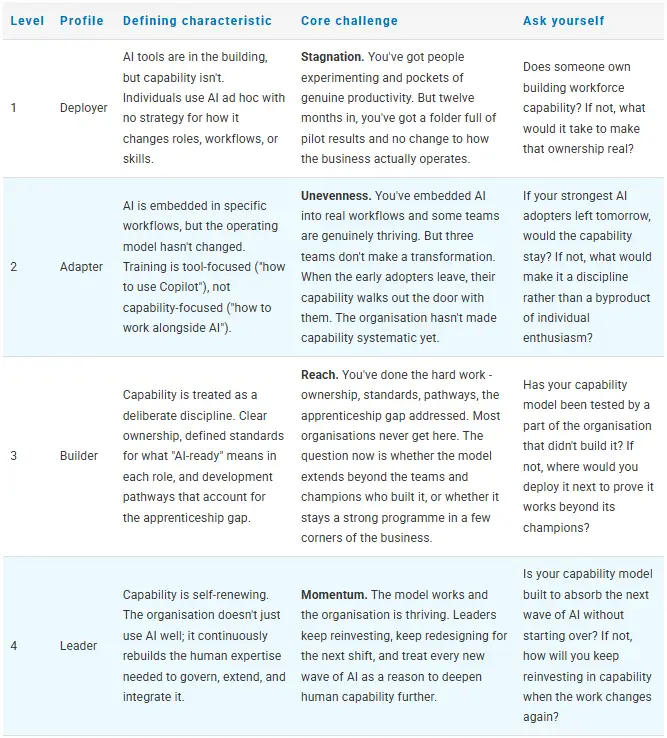
| Level | Profile | Defining characteristic | Core challenge | Ask yourself |
|---|---|---|---|---|
| 1 | Deployer | AI tools are in the building, but capability isn't. Individuals use AI ad hoc with no strategy for how it changes roles, workflows, or skills. | Stagnation. You've got people experimenting and pockets of genuine productivity. But twelve months in, you've got a folder full of pilot results and no change to how the business actually operates. | Does someone own building workforce capability? If not, what would it take to make that ownership real? |
| 2 | Adapter | AI is embedded in specific workflows, but the operating model hasn't changed. Training is tool-focused ("how to use Copilot"), not capability-focused ("how to work alongside AI"). | Unevenness. You've embedded AI into real workflows and some teams are genuinely thriving. But three teams don't make a transformation. When the early adopters leave, their capability walks out the door with them. The organisation hasn't made capability systematic yet. | If your strongest AI adopters left tomorrow, would the capability stay? If not, what would make it a discipline rather than a byproduct of individual enthusiasm? |
| 3 | Builder | Capability is treated as a deliberate discipline. Clear ownership, defined standards for what "AI-ready" means in each role, and development pathways that account for the apprenticeship gap. | Reach. You've done the hard work - ownership, standards, pathways, the apprenticeship gap addressed. Most organisations never get here. The question now is whether the model extends beyond the teams and champions who built it, or whether it stays a strong programme in a few corners of the business. | Has your capability model been tested by a part of the organisation that didn't build it? If not, where would you deploy it next to prove it works beyond its champions? |
| 4 | Leader | Capability is self-renewing. The organisation doesn't just use AI well; it continuously rebuilds the human expertise needed to govern, extend, and integrate it. | Momentum. The model works and the organisation is thriving. Leaders keep reinvesting, keep redesigning for the next shift, and treat every new wave of AI as a reason to deepen human capability further. | Is your capability model built to absorb the next wave of AI without starting over? If not, how will you keep reinvesting in capability when the work changes again? |
Most organisations sit at Level 1 or 2. They’ve started the adoption. What they haven’t done is turn it into capability – the kind that stays in the organisation when the tools change or the people move on. That shift, from Level 2 to Level 3, is where adoption becomes capability. It’s the point where the organisation stops asking “are people using AI?” and starts asking “is the organisation getting stronger because of it?”
What leaders do differently

The organisations at Level 4 share a few characteristics that the ones at Level 1 don’t. None of them are about technology.
-
They redesign the apprenticeship, not just the workflow.
Most organisations redesign how work gets done. Leaders go further - they redesign how expertise is built. Structured case reviews, deliberate exposure to edge cases, paired work where juniors observe senior decisions in real time. The method matters less than the intention: in an AI-assisted environment, expertise doesn't build itself. -
They measure whether the organisation is getting stronger, not whether people are using the tools.
Adoption metrics tell you activity. They don't tell you capability. Leaders track whether decisions are improving, whether judgement is deepening, whether capability transfers from individuals to the organisation. They measure leading indicators (decision quality, time-to-judgement, capability transfer) because those are the signals that adoption is becoming capability. -
They make capability someone's job, not everyone's side project.
Capability doesn't become a discipline by accident. It becomes a discipline when someone owns it with budget, authority, and accountability. The organisations that move from Level 2 to Level 3 are the ones who stop treating capability as a byproduct and start treating it as a function. -
They design the human-AI system before they deploy, not after.
Most organisations deploy AI and then train people. Leaders design the human-AI system as one - deciding what the AI does, what the human does, and how the two interact - before deployment. This is the difference between AI that works and AI that lands.
The pilot era asked one question: can AI do this? The answer, increasingly, is yes. The capability era asks a different question: can your people grow with it?
The organisations that answer yes won’t be the ones with the most sophisticated deployments. They’ll be the ones who turned AI adoption into workforce capability: a deliberate, measurable, repeatable discipline.