




Earlier this week, an Australian government agency revealed it had considered terminating a major contract after a contractor’s employee sent a sensitive document from the wrong email account. Not a hack. Not a ransomware attack. A simple data-handling slip and the agency weighed ending a A$650 million contract relationship over it.
It’s Cybersecurity Awareness Month, and that story is a useful reminder: most security incidents aren’t cinematic. They’re ordinary mistakes with expensive consequences. The good news? There’s a structured, practical way to prevent them: cybersecurity frameworks. They’re your digital playbook for managing risk, staying compliant, and keeping your business running when things go wrong.
Here’s what the latest numbers tell us:
- AU$347 billion - projected global spending on information security in 2026, up 11.6% on the previous year
- AU$7.1 million - the global average cost of a data breach in 2026, a 12% jump year-on-year
- AU$4.2 million - the average breach cost in Australia, up from AU$3.6 million in 2025
- 84,000+ - cybercrime reports received by the Australian Cyber Security Centre in 2024–25, with medium-sized businesses facing an average cost of $97,200 per incident
- 96% - of senior security leaders who say AI-enabled cyber attacks are now a significant threat to their organisation
In this guide, we’ll break down the frameworks that matter most for Aussie businesses and how to put them into action.
What are cybersecurity frameworks and which ones matter?

A cybersecurity framework is a structured set of guidelines, best practices, and standards for identifying risks, protecting assets, detecting threats, responding to incidents, and recovering from breaches. They’re flexible, scalable, and built to be tailored to your business – not one-size-fits-all.
Four frameworks and standards stand out for Australian businesses:
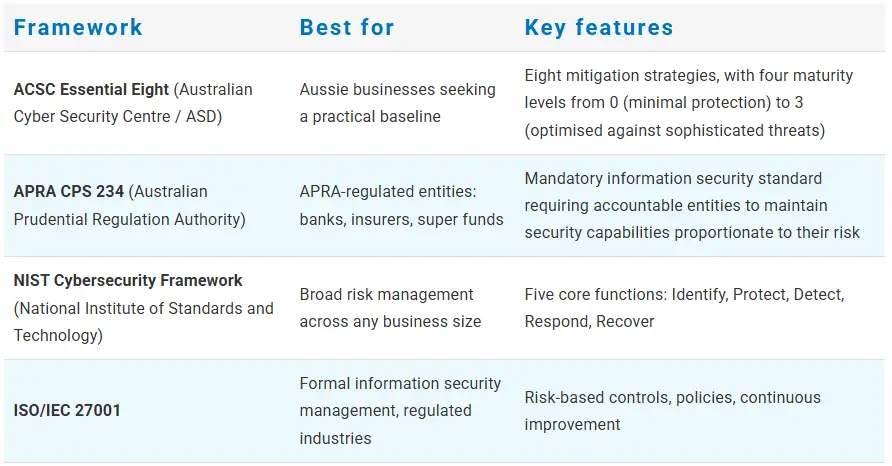
| Framework | Best for | Key features |
|---|---|---|
| ACSC Essential Eight (Australian Cyber Security Centre / ASD) | Aussie businesses seeking a practical baseline | Eight mitigation strategies, with four maturity levels from 0 (minimal protection) to 3 (optimised against sophisticated threats) |
| APRA CPS 234 (Australian Prudential Regulation Authority) | APRA-regulated entities: banks, insurers, super funds | Mandatory information security standard requiring accountable entities to maintain security capabilities proportionate to their risk |
| NIST Cybersecurity Framework (National Institute of Standards and Technology) | Broad risk management across any business size | Five core functions: Identify, Protect, Detect, Respond, Recover |
| ISO/IEC 27001 | Formal information security management, regulated industries | Risk-based controls, policies, continuous improvement |
Where to start?
For most Aussie businesses, the Essential Eight is the natural starting point; it’s practical, locally focused, and built for the Australian threat landscape. If you’re an APRA-regulated entity, CPS 234 compliance is non-negotiable. NIST offers a broader, more adaptable structure for managing complex risk. ISO 27001 is the go-to if you need formal certification to prove your security credentials to clients, partners, or regulators.
From assessment to action: your practical path forward

You don’t need an IT degree to get started. Here’s a three-phase approach to assessing your posture and aligning with a framework.
Phase 1: Know where you stand
- Inventory your digital assets: What's on your network? Hardware, software, cloud services, critical data - list it all.
- Identify potential threats: Phishing, ransomware, insider threats, supply chain attacks. What could go wrong?
- Review existing controls: Strong passwords? Regular backups? Who has access to what?
- Benchmark against a framework: Use the Essential Eight, NIST, ISO 27001, or CPS 234 to see where you're hitting the mark, and where you're falling short.
Phase 2: Close the gaps
- Set clear objectives: What are your security goals? Reducing risk? Gaining certification? Protecting customer trust?
- Run a gap analysis: Compare your current practices to your chosen framework. Prioritise what matters most.
- Build an action plan: Break tasks into manageable chunks (patching software, updating policies, running training sessions, upgrading backups).
- Document everything: Good records aren't just for compliance. They're essential during incidents and audits.
Phase 3: Know when to get help
Some things are best left to experts. If you’re feeling stretched, that’s a sign (not a weakness). Cybersecurity specialists can:
- Perform deep-dive assessments you might miss on your own
- Help you choose and tailor the right framework for your business
- Train your staff and build a culture of security awareness
- Develop incident response plans so you're ready before something goes wrong
Frameworks only work if you use them
Cybersecurity frameworks give you the structure to manage risk, stay compliant, and build resilience – and there’s no better time to start than Cybersecurity Awareness Month. You don’t have to figure it out alone. At Intelliworx, we make it straightforward: from assessments to implementation, we’ll tailor solutions to protect your business and keep it moving forward.
References
• Forecast Analysis: Information Security, Worldwide, 2026 (Gartner, February 2026)
• Cost of a Data Breach Report 2026 (Statista, August 2026)
• Global Cybersecurity Outlook 2026 (World Economic Forum, January 2026)
• Cyber security solutions for mid-market businesses (Australian Cyber Security Centre, 2025)
• EY Cybersecurity Roadmap Study (EY, March 2026)