




Artificial intelligence has become woven into the fabric of industries across Australia and the globe. It is transforming how businesses operate – streamlining processes, uncovering opportunities, and driving innovation at an unprecedented pace. But as AI opens doors, it also expands the attack surface for cyber threats. The integration of AI into our systems means there is now more to protect.
Eighteen months ago, I wrote about cybersecurity excellence in the omnipresence of AI. The thesis was simple: AI is both the challenge and the solution, and organisations that find the balance between innovation and security will thrive. That thesis has not changed. What has changed is the speed, the scale, and the stakes.
In 2026, AI is no longer a tool that organisations are evaluating. It is a tool they are deploying, often faster than they can secure it. The data tells a clear story of acceleration, tension, and gap. This updated piece revisits that original thesis with 2026 evidence, examining how the rise of AI has broadened cyber risks, how AI is equipping businesses with defensive capabilities, and what cybersecurity excellence looks like in practice for Australian organisations today.
The acceleration gap: AI adoption outpacing AI security
The most striking shift since the original piece is not the emergence of new threats; it is the speed at which organisations have adopted AI without commensurate investment in securing it.
- 96% of senior security leaders say AI-enabled cybersecurity attacks are a significant threat to their organisation, yet less than half are strongly confident in their ability to defend against a major AI-enabled breach
- 85% of senior security leaders say their current cybersecurity budget is insufficient to meet AI-enabled threats
- 83% of organisations reported an increase in cyberattacks over the past 12 months
- Only 24% have fully integrated AI into their cybersecurity operations, while 53% have partially implemented it
- 57% of employees use personal GenAI accounts for work purposes, and 33% admit inputting sensitive information into unapproved tools
- 94% of organisations say AI is the most significant driver of change in cybersecurity
- The percentage of organisations assessing the security of AI tools has nearly doubled, from 37% in 2025 to 64% in 2026, but only 41% have formal AI governance policies in place
- 48% of senior security leaders estimate at least a quarter of their organisation's cybersecurity incidents in the past year were enabled by AI
- 90% of organisations deem collaboration among IT, security, and risk teams critical to safeguarding AI systems
- Australian organisations are forecast to spend over AU$7.5 billion on information security in 2026, up 9.5% from 2025, with security software spending growing 12.3% to AU$3.3 billion
- 50% of all enterprise cybersecurity incident response efforts will focus on incidents involving custom-built AI-driven applications by 2028
- Organisations with extensive AI and automation capabilities save approximately AU$2.8 million per breach due to faster detection and reduced remediation effort
AI's dual role: innovation and vulnerability
AI’s role in cybersecurity is fundamentally dual. Every capability it introduces creates a corresponding risk. Understanding this duality is the foundation of cybersecurity excellence in 2026.
Agentic AI and autonomous systems
Innovation: AI agents are taking on complex, multi-step security tasks – from threat hunting to incident response – operating continuously and at machine speed. A growing share of organisations are running advanced persistent threat detection with agentic AI, and that adoption is expected to more than double within two years.
Vulnerability: The same agentic capabilities that power defence are being weaponised by attackers. Agentic AI is creating new attack surfaces: unmanaged agent proliferation, unsecured code, and regulatory compliance violations. Organisations are deploying agents faster than they can govern them.
Generative AI and data exposure
Innovation: Generative AI tools are embedded across workflows, from document analysis to code generation to client communications, dramatically accelerating productivity and insight generation.
Vulnerability: The attack surface has expanded not through infrastructure but through behaviour. A majority of employees now use personal GenAI accounts for work, and a third admit inputting sensitive information into unapproved tools. Every employee using an unapproved AI tool is a potential data exposure point.
AI-powered threat detection and response
Innovation: AI compresses the time between detection and response, enabling organisations to identify and contain threats in real time rather than after the fact. Organisations with extensive AI and automation capabilities save significantly per breach due to faster detection and reduced remediation effort.
Vulnerability: AI is also automating attacks, making them more adaptive and challenging traditional defences. AI compresses the time between reconnaissance, exploitation, and escalation; intrusions progress too quickly for manual analysis or static signatures to keep pace. The same speed that benefits defenders benefits attackers.
AI governance and trust
Innovation: Organisations are maturing their approach to AI risk. The percentage assessing the security of AI tools has nearly doubled in a single year. AI trust frameworks are moving from optional to operational.
Vulnerability: Despite this progress, fewer than half of organisations have formal AI governance policies in place. Organisations are now managing more AI-related risks than ever, but the governance infrastructure still lags behind the risk surface.
Third-party and supply chain AI
Innovation: AI is strengthening third-party risk management; predictive analytics can identify vendor vulnerabilities before they cascade, and continuous monitoring replaces periodic assessments.
Vulnerability: The supply chain now includes AI applications built by third parties, each introducing novel threats such as prompt injection and tool misuse that bypass legacy security. Organisations are securing their own AI while leaving vendor AI unexamined.
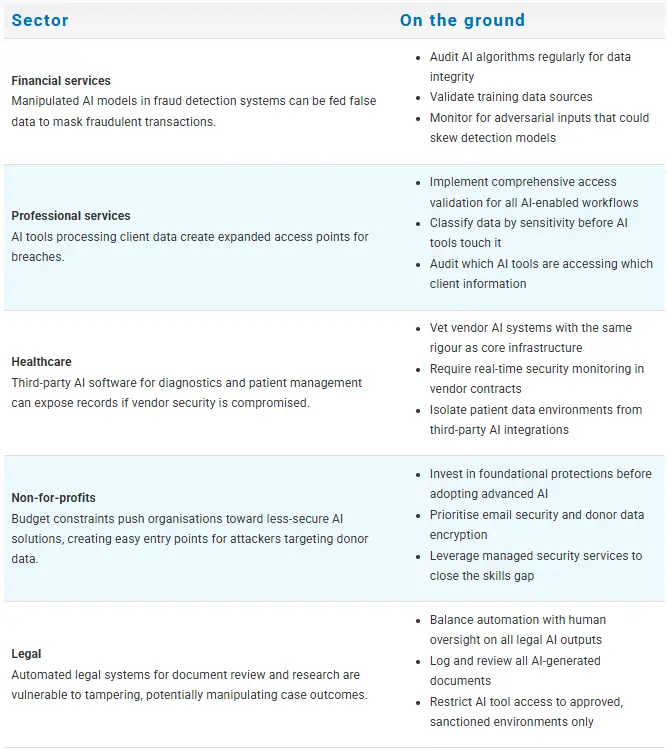
The duality of AI: Sector by sector
| Sector | On the ground |
|---|---|
| Financial services Manipulated AI models in fraud detection systems can be fed false data to mask fraudulent transactions. |
|
| Professional services AI tools processing client data create expanded access points for breaches. |
|
| Healthcare Third-party AI software for diagnostics and patient management can expose records if vendor security is compromised. |
|
| Non-for-profits Budget constraints push organisations toward less-secure AI solutions, creating easy entry points for attackers targeting donor data. |
|
| Legal Automated legal systems for document review and research are vulnerable to tampering, potentially manipulating case outcomes. |
|
Redefining cybersecurity excellence for 2026

When I first wrote about cybersecurity excellence in the age of AI, the framing was about balance: finding the equilibrium between innovation and protection. Eighteen months on, that framing still holds, but it needs sharpening.
The organisations that will thrive are not those that deploy the most AI or those that restrict it the most. They are the ones that build the governance, the culture, and the operational discipline to move at the speed AI demands without leaving security behind.
Cybersecurity excellence in 2026 means three things. First, treating AI security as a governance issue, not just a technical one: every AI agent needs an identity, an owner, and a boundary. Second, investing in the capabilities that compress the gap between detection and response, because that gap is where attackers live. Third, building a culture where AI risk is part of everyday conversation, not an annual compliance exercise.
The organisations that embed these principles will not just survive the AI era. They will lead in it.
Sources
- Gartner, Forecasts information security spending in Australia to reach over AU$7.5 billion in 2026 (March 2026)
- Gartner, Identifies the top cybersecurity trends for 2026 (February 2026)
- Gartner, Predicts AI applications will drive 50% of cybersecurity incident response efforts by 2028 (March 2026)
- Gartner, Identifies four critical threats requiring urgent improvements from cybersecurity leaders (June 2026)
- Gartner, Forecasting the $16.4 billion opportunity in securing AI (July 2026)
- KPMG, 2026 Cybersecurity & Technology Risk Survey (June 2026)
- KPMG, Cybersecurity considerations 2026 (June 2026)
- KPMG, Global tech report 2026: Private company (March 2026)
- EY, The AI landscape in cybersecurity (March 2026)
- EY, Global Cybersecurity Leadership Insights Study 2026 (June 2026)
- EY, Cyber resilience in an era of AI-enabled offense (December 2025)
- McKinsey, State of AI trust in 2026: Shifting to the agentic era (March 2026)
- McKinsey, The State of AI: Global Survey 2026 (August 2026)
- World Economic Forum, Global Cybersecurity Outlook 2026
- Statista, Information security spending in Australia 2026 (March 2026)
- Statista, Cybersecurity market forecast: Australia and Oceania (2026)