




TL;DR: Australian finance and insurance is now the third most-targeted sector for cyber incidents. With the Cyber Security Act 2024 in force, ASIC taking licensees to court, and APRA sharpening its cyber and AI expectations, smarter security has become a competitive advantage – not just a compliance box. Here’s how to build a stronger 2026 security posture around CPS 234, the Essential Eight, zero-trust, and sound AI governance.
Security in 2026: Where finance and insurance stands
The data is hard to ignore:
- Finance and insurance jumped from 8th to 3rd most-targeted sector in Australia (Chambers & Partners, Cybersecurity 2026)
- 7% of all incidents reported to the Australian Signals Directorate (ASD) came from the sector
- ASD's 2024–25 Annual Cyber Threat Report recorded an 11% rise in incidents overall
Attackers know where the money and data sit.
The regulatory response has been swift:
- Cyber Security Act 2024: Australia's first standalone cyber law, introducing mandatory ransomware payment reporting and new national oversight roles
- ASIC: moved from warnings to court action, pursuing FIIG Securities and Fortnum Private Wealth over inadequate cyber controls
- Horizon 2: Australia's national strategy to lift security maturity across the whole economy, now in active implementation
The pressure is real – and so is the opportunity. Organisations that embed security as a genuine capability earn customer trust, negotiate better premiums, and stay ahead of both regulators and attackers.
3 strategic questions in 2026

These are not audit questions. They are three fast leadership checks; answer each one honestly, then follow the guidance that applies.
- Does our security model reflect how we actually operate today?
If yes:
Good. Keep reviewing cloud access, third-party dependencies, and control coverage as your environment changes.
If no:
Start with your highest-risk systems and vendors. Map where sensitive data sits and where older controls no longer fit.
- Do we have enough visibility to spot threats early and respond fast?
If yes:
Strong position. Keep testing alert quality, escalation speed, and coverage across critical systems.
If no:
Prioritise visibility across identities, endpoints, cloud platforms, and critical services. You cannot contain what you cannot see.
- Are our critical services and incident response ready to hold up under pressure?
If yes: That’s a real strength. Keep exercising recovery, communications, and decision-making under realistic scenarios.
If no:
Focus on the basics first: defined roles, escalation paths, recovery priorities, and a tested response plan for critical services.
Smarter security in action: a tech-centric approach
Different parts of the finance and insurance sector face different risks — and the right security focus varies accordingly. Here’s a quick snapshot of where to direct your attention, and what to do about it.
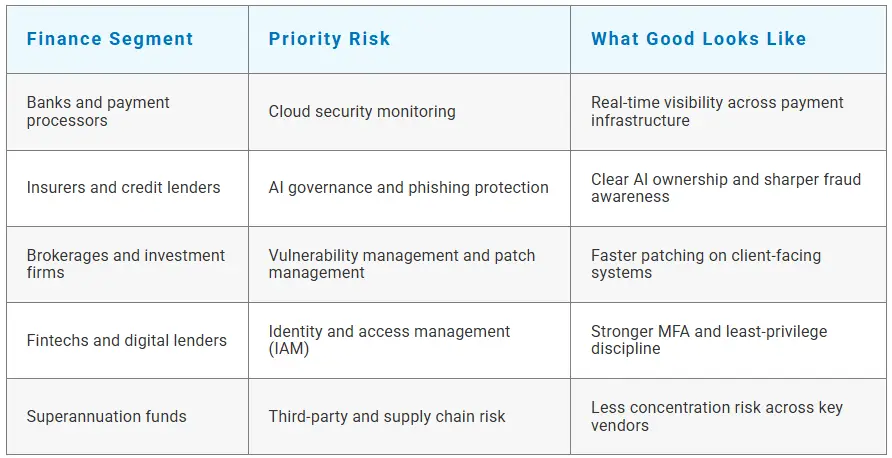
| Finance segment | Priority risk | What good looks like |
|---|---|---|
| Banks and payment processors | Cloud security monitoring | Real-time visibility across payment infrastructure |
| Insurers and credit lenders | AI governance and phishing protection | Clear AI ownership and sharper fraud awareness |
| Brokerages and investment firms | Vulnerability management and patch management | Faster patching on client-facing systems |
| Fintechs and digital lenders | Identity and access management (IAM) | Stronger MFA and least-privilege discipline |
| Superannuation funds | Third-party and supply chain risk | Less concentration risk across key vendors |
What stronger cyber resilience looks like in practice
Here’s what strong execution looks like across the priorities APRA flagged in its May 2026 System Risk Outlook – and what ASIC is actively enforcing right now.
1. Manage provider concentration risk
APRA has specifically called out concentration risk when many institutions lean on the same handful of providers, one outage can ripple across the system. Map your critical dependencies, including AI vendors, and stress-test what happens if a key one goes dark. Build clear expectations into contracts, so a single point of failure doesn’t become your failure.
2. Tighten access controls
APRA’s recent AI letter singled out weak identity controls as a live concern. Multi-factor authentication, privileged access management, and role-based access shrink the damage when credentials are compromised. In a sector where staff handle sensitive customer and financial data daily, IAM is one of the highest-return investments you can make.
3. Protect data across its full lifecycle
CPS 234 makes your board ultimately responsible for protecting information assets in line with their sensitivity. That means classifying data at creation, encrypting it in transit and at rest, masking it in test environments, and disposing of it properly. With tokenised finance on the rise, APRA has also flagged fresh operational and cyber considerations worth building into your data controls now.
4. Apply zero-trust principles
Remote teams, cloud apps, and third-party integrations have quietly dissolved the old network perimeter. Zero-trust applies a “never trust, always verify” check to every access request, wherever it comes from. It’s especially effective against compromised credentials and insider threats – two vectors regulators keep raising.
5. Rehearse your incident response
ASIC cyber security enforcement action has shown how quickly inadequate controls become a legal matter, with firms penalised millions after intrusions went unnoticed or uninvestigated for too long. A documented, regularly rehearsed response plan is the difference between a contained event and a headline. Run realistic simulations, and make sure everyone with a role knows it before a crisis, not during one.
6. Build team security instincts
Phishing and stolen credentials remain top causes of breaches in the ASD data. Move past annual awareness sessions toward scenario-based drills and simulated phishing that reflect the threats your people actually face. The aim is genuine instinct – the split-second pause before someone clicks.
7. Govern AI at the board level
APRA’s May 2026 outlook was blunt: AI adoption is racing ahead while governance lags, and boards aren’t always keeping pace. Set clear accountability for AI systems, and fold geopolitical risk readiness (payments contingency, supplier risk, crisis planning) into your enterprise risk management. Regulators now expect this at the top table, not buried in an IT report.
Building a resilient future with Intelliworx

Security is now a measurable business input – one that affects regulatory standing, customer retention, and the pace at which you can move. The organisations managing it well in 2026 aren’t doing more; they’re doing it with more structure and visibility.
Intelliworx works with Australian finance and insurance organisations to put that structure in place. Our managed SOC services provide continuous threat detection and response across your environment, while our AI consulting services help you build governance frameworks that meet what APRA and regulators now expect at the board level.